



Supply Chain Management Trends: Career Opportunities for Management Graduates
Sep 29, 2026
Read More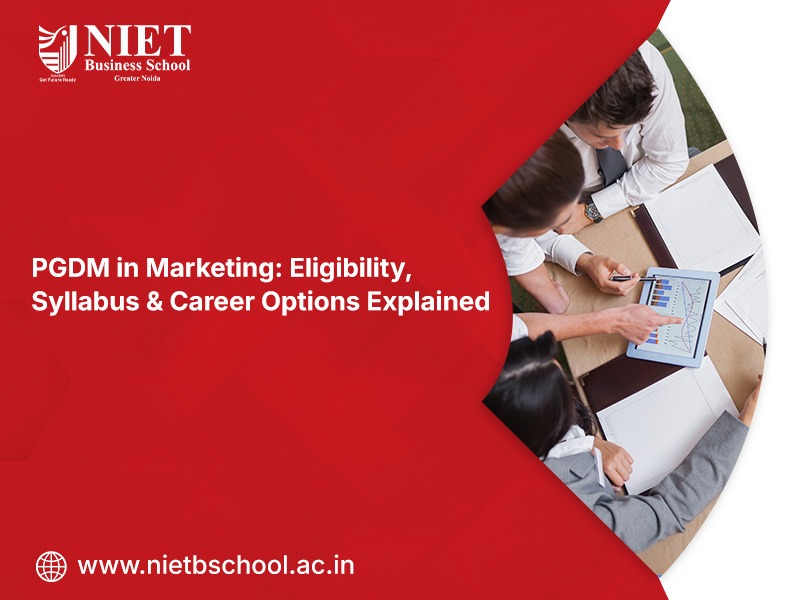
Making a decision about your career after completing school can present many opportunities to ask questions. A common query might centre around, “How do you build a successful business?” These individuals usually enjoy determining what motivates certain consumers to buy products over others or why certain brands become successful. If that describes you, you are likely meant to become a business leader! The best way to get a head start on your corporate career is by pursuing a PGDM in Marketing.
You will soon understand that professional education is the means of taking your creative ideas and making them into a successful profession. This type of diverse career involves leading teams and resolving actual business challenges. The people who choose this path are focused on that! When you attend a top business school, you aren’t just educated; you’ve evolved!
The professional qualification of Postgraduate Diploma in Management, or PGDM, serves as a bridge between theory learned in school and what is required in the real world by employers. A PGDM in Marketing Management is strictly focused on what is current in the world of Marketing, and as such, you will learn the very skills that employers want from new employees.
The PGDM in Marketing syllabus is updated on an annual basis to reflect what is currently happening in Marketing, and the inclusion of new technology, such as Artificial Intelligence (AI) or Digital Tools, will ensure that the material learned in class is able to be used in the modern workplace when you graduate. This will give you a clear understanding of Marketing Management, effective leadership, and the skills required to operate a successful business.
There are some specific eligibility requirements for PGDM admission into this highly regarded PGDM program. This is a path that starts after foundational education has been completed and requires an applicant’s undivided commitment.
| Module Category | Core Subjects & Topics |
| Digital Dominance | Digital Marketing, SEO, Social Media Analytics, and Google Ads. |
| Consumer Insights | Consumer Behaviour, Psychology of Buying, Market Research. |
| Advanced Tools | Business Analytics, Data Visualisation, Marketing Metrics. |
| Future Tech | Innovation and AI, Generative AI for Business, E-commerce. |
| Core Management | Strategic Management, Financial Accounting, Operations. |
After grad school, your career options aren’t just broad – they’re solid. Every company, big or small, needs people who can bring customers in and build brand trust.
Many students ask, “What is the difference between these two tracks?” A PGDM will typically have more flexibility in terms of its curriculum than an MBA would (i.e., they will allow for live projects and paid internships that may not be available under traditional MBA programs due to affiliation agreements with universities).
Due to the presence of significant industrial and IT parks in Greater Noida, numerous graduate students regularly seek out a PGDM (Post Graduate Diploma in Management) business school in the area. The proximity to these corporate entities offers students a tremendous opportunity for internship placements. For instance, as they look for the best PGDM college in Greater Noida, students at NIET Business School utilise the expertise of their “real boss” mentors throughout their studies at marketing management. By being close to these businesses, students are afforded easy access to employment opportunities as soon as they graduate, often leading to high salaries.
Identifying the right mentor for your career is crucial to achieving success. NIET Business School in Noida is an institution of excellence with a socially aware and industry-focused leadership programme designed to take you through an effective transformation.
The two-year PGDM in Marketing has a very unique combination of theoretical knowledge and practical experience gained through working on real-time projects. By focusing on digital literacy and Artificial Intelligence, this course ensures that the students are fully prepared for a highly competitive work environment. Join a network of 20,000 students who can work on innovations together and develop collaborative relationships with some of the best students in India.
About Read About:
PGDM in Finance
PGDM in HR
PGDM in Business Analytics
FAQS
1. Who should choose PGDM in Marketing as a career option?
This career path is ideal for individuals who possess a mix of creative thinking and analytical skills. If you enjoy understanding consumer psychology, stay updated with digital trends (like AI and social media), and have strong communication skills to influence others, you are a perfect candidate. It is suited for those who want a dynamic, fast-paced work environment where they can see the direct impact of their strategies on a company’s growth.
2. What are the career opportunities after PGDM in Marketing?
Graduates can explore diverse roles across industries like FMCG, Tech, E-commerce, and Banking. Common job profiles include:
3. What is the eligibility criteria and fees for PGDM in Marketing in India?
4. Which marketing roles offer the highest salary after PGDM?
Leadership and tech-integrated roles typically command the highest packages.
5. Can PGDM in Marketing lead to a 10 LPA+ salary package?
Yes, graduates from Tier-1 and top Tier-2 business schools frequently secure starting packages of 10 LPA to 15 LPA+, especially in sectors like Tech, Consulting, and FMCG.
Sep 29, 2026
Sep 28, 2026
Sep 23, 2026
Sep 22, 2026
Aug 31, 2026
Sep 29, 2026
Read More
Sep 28, 2026
Read More
Sep 23, 2026
Read More
Sep 22, 2026
Read More