




Supply Chain Management Trends: Career Opportunities for Management Graduates
Sep 29, 2026
Read More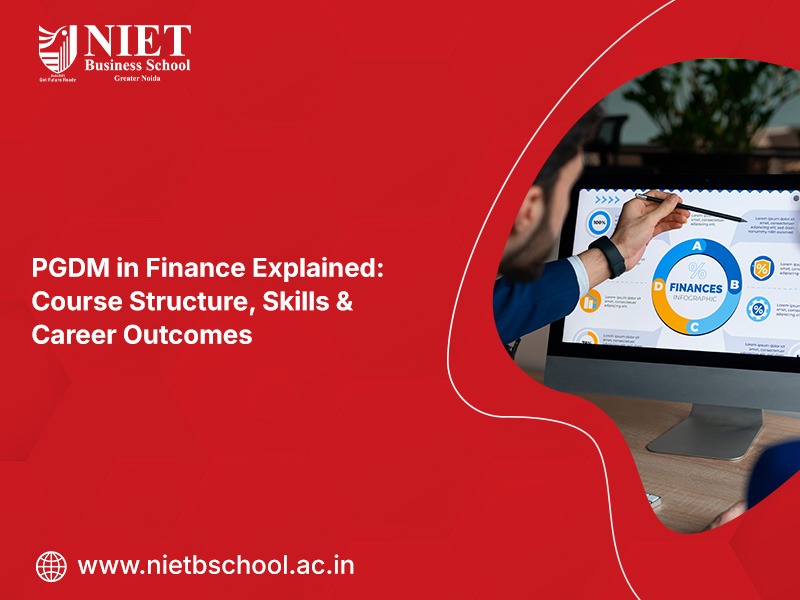
With Financial Markets now being more volatile and connected, it is imperative to have a specialized education to keep pace with the Competition. Choosing to obtain a PGDM in Finance is more than just an academic path; it is a strategic investment towards having a Career Future involving high-level Decision Making on a Global Level.
At NIET Business School, the PGDM program is a two-year full-time program, and it has been created to develop students into future Business Leaders with a strong Practical and Theoretical foundation. The incorporation of Gen AI into the curriculum will make the students develop an Architect of the Global Financial Environment versus being spectators. Therefore, whether you are looking for the Top PGDM Colleges or looking for PGDM admission and their criteria, the first step in pursuing a lucrative Career is understanding the depth of the Program.
A PGDM (Post Graduate Diploma in Management) with Finance concentration is a post-graduate degree that emphasizes the management of monetary resources (money), asset base (assets), and liabilities (liabilities) through the lens of business and not as a Generalist or an MBA. The PGDM programs offered by PGDM Colleges in Noida and PGDM Colleges in Delhi NCR are designed to adapt to changing industrial trends.
The curriculum of PGDM Program is continuously revised to provide updated content such as Financial Modeling, Risk Assessment and Data Driven Decision Making. The flexible PGDM curriculum will help bridge the gap between economic theory and the realities of the current globalized marketplace.
The usual PGDM (Post Graduate Diploma in Management) program generally follows a two year system arranged in trimesters of either four or six. The first trimester will cover foundational knowledge and skills required for General Financial Management, and after this, the student will delve into specific areas of finance.
| Phase | Focus Areas | Key Subjects |
| Year 1 | Foundation of Management | Accounting for Managers, Microeconomics, Quantitative Methods, Organizational Behavior |
| Year 2 | Financial Specialization | Security Analysis, Portfolio Management, Derivatives, Corporate Tax Planning, Fintech |
| Practical | Experiential Learning | Paid Internships, Live Consulting Projects, Innovation Labs, Case-based Learning |
To be successful working in stressful financial situations, students need a combination of technical skills and leadership abilities. To assist students in this process, the PGDM program includes:
Students must satisfy a specific set of criteria in order to apply to a top PGDM in Finance (Post Graduate Diploma in Financial Management) business school d In most cases, this means obtaining a valid bachelor’s degree from an approved university with at least a minimum score of 50%. Typically, admissions to these programs are determined on the basis of an entrance examination, such as CAT, MAT, XAT, or CMAT, and interviews will then usually take place.
With respect to financing a PGDM program, fees depend on the institution offering the course. Due to the premium nature of many Finance programs, their fees may seem high, but the majority of graduate PGDM students experience a strong return on investment through the PGDM placement opportunities and subsequent salaries that follow.
Financial Management education is greatly affected by the location of your school. There are many reasons you might choose to go to the best PGDM college in Noida because of its geographic advantage. Noida is one of the largest corporate hubs in the country, home to numerous multinational companies and Finance consulting firms
Benefits:
A significant measure of a program’s success is the professional return on investment it provides. With respect to job prospects in finance, PGDM graduates possess numerous opportunities to pursue careers with high salaries across the country. Some examples of positions available to graduates who earn their PGDM at a top PGDM college, such as NIET Business School include the following:
NIET Business School is focused on making a positive impact on your life through its PGDM program, with an emphasis placed on being part of a community made up of more than 20,000 students. The innovation and adaptability found in our ecosystem help us achieve the educational goals of our students.
In addition to providing a Technology Business Incubator where aspiring entrepreneurs can develop their financial models into actual start-up companies, we also prepare our graduates with the knowledge and skills necessary to be an integral member of an organization by teaching them Business Analytics and Supply Chain.
Selecting an appropriate PGDM course is critical for bridging your potential with your future success by closing the gap between your academic and professional knowledge. A small number of candidates have the basic analytical skills and the drive needed for success within the finance industry, but a specialised PGDM in Finance at NIET Business School will provide the essential design through advanced analytical methods, networking, and exposure to real business activities that will turn this latent ability into real-world corporate success.
At NIET Business School, we view our creation of a certificate of graduation as one step in the process of transitioning our graduates into “architects” of the modern economy. This journey requires the evolution of behaviour and professional capability, including high-stakes negotiation skills, emotional intelligence, and a strategic mind, which can be the foundation for future leadership in a global boardroom.
Also Read About:
FAQS
1. What is PGDM in Finance?
A PGDM in Finance (Post Graduate Diploma in Management) is a specialized two-year professional program focused on the strategic management of financial resources, assets, and market liabilities. Unlike a traditional MBA, which follows a university-defined syllabus, a PGDM is offered by autonomous institutes like NIET Business School, allowing the curriculum to be updated annually to include modern industry trends like Fintech, Gen AI, and Blockchain.
2. What subjects are covered in PGDM Finance?
The program transitions students from management foundations to specialized financial expertise across four or six trimesters:
3. What are the top career opportunities after PGDM in Finance?
Graduates are eligible for high-stakes roles in diverse financial sectors:
4. Is PGDM in Finance a good option for future growth?
Yes, it is an excellent investment for long-term growth. As global markets become more data-driven, professionals who can blend traditional financial wisdom with modern tools like AI and Business Analytics are in high demand. The program’s focus on “global mobility” and “hands-on corporate mentorship” ensures that graduates can navigate volatile markets and secure leadership positions worldwide.
5. Is the PGDM program at NIET Business School approved by AICTE?
Yes, the PGDM program at NIET Business School is fully approved by the AICTE (All India Council for Technical Education), Government of India. Additionally, the program is recognized as an MBA Equivalent by the Association of Indian Universities (AIU) and holds prestigious NBA (National Board of Accreditation) and AACSB international accreditation, ensuring the highest standards of management education.
Sep 29, 2026
Sep 28, 2026
Sep 23, 2026
Sep 22, 2026
Aug 31, 2026
Sep 29, 2026
Read More
Sep 28, 2026
Read More
Sep 23, 2026
Read More
Sep 22, 2026
Read More